Gravion Pest ControlGravion Pest Control

Wasp & Bee Removal Buffalo

Stinging insect infestations in Erie County follow distinct seasonal and architectural patterns. Buffalo's high concentration of 19th- and early 20th-century wood-frame residences, such as Victorian structures in…
Get My Free Estimate →(716) 503-3109
Wasp & Bee Removal in Buffalo, NY
Quick answer
  • What is included: Species identification, diagnostic thermal or acoustic inspection of voids, targeted colony neutralization or live honeybee relocation coordination, full nest extraction where accessible, and exterior point-of-entry sealing.
  • Response timeframe: Same-day service is deployed for high-hazard exterior nests within 2 to 4 hours across Buffalo, with non-emergency structural void extractions scheduled within 24 to 48 hours.
  • Cost standard: Professional removal pricing ranges between $150 and $450 depending on nesting depth, height above grade, and whether interior wall void cavity access is required; exact figures are confirmed during an on-site structural audit.
  • Targeted species: Paper wasps (Polistes), bald-faced hornets (Dolichovespula maculata), yellowjackets (Vespula), European hornets (Vespa crabro), carpenter bees (Xylocopa virginica), and nesting honeybees (Apis mellifera).
  • Booking protocol: Direct dispatch arrangements are handled by phone at (716) 503-3109, or property managers can text high-resolution photos of the nesting site and roofline for preliminary structural triage.

Stinging insect infestations in Erie County follow distinct seasonal and architectural patterns. Buffalo's high concentration of 19th- and early 20th-century wood-frame residences, such as Victorian structures in Allentown, Queen Anne homes in Elmwood Village, and American Foursquares in North Buffalo, feature extensive uninsulated soffits, lath-and-plaster wall cavities, open eaves, and decorative fascia boards. In late spring, fertilized queen wasps emerge from winter diapause to build starter nests within these unsealed gaps. By July and August, a yellowjacket colony in a second-story wall void can expand to over 4,000 workers. While exposed paper wasp umbrellas hanging from an exterior porch rail can be addressed through direct mechanical knockdown and micro-aerosol application, wall void infestations require structural acoustic tracking and precision dusting directly into the entry seam. Store-bought expanding foams or retail aerosol sprays often backfire in these situations; sealing the exterior flight hole while the subterranean or wall-void colony remains active forces thousands of defensive insects into the living quarters through interior electrical switch plates, recessed lights, and baseboard seams.

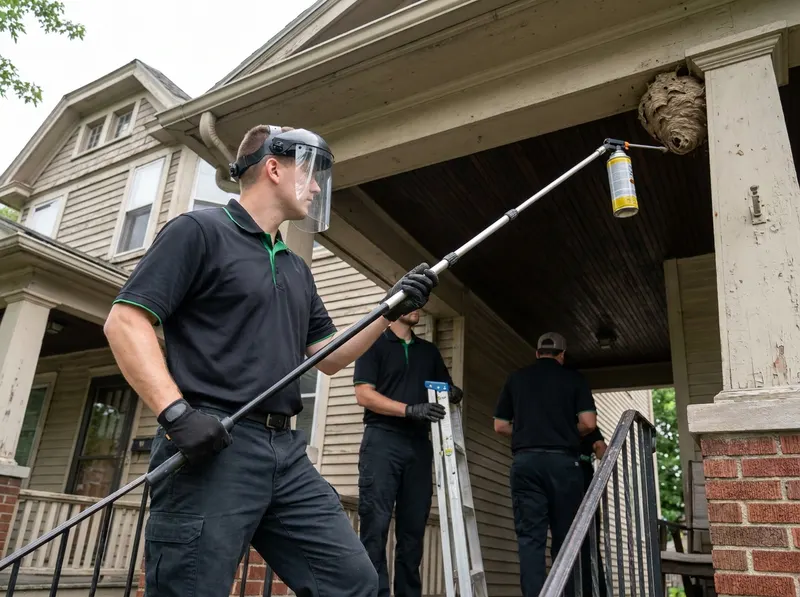
Selecting the correct mitigation strategy depends entirely on species biology and nest location. For aerial hornets constructing large football-shaped paper envelopes in Delaware Park-adjacent tree canopies or beneath Parkside roof peaks, technicians utilize non-repellent freeze-compounds and vacuum extraction rigs from telescoping lances, eliminating the protective colony without broadcasting airborne chemicals. When managing ground nests commonly found in the clay-heavy soils of South Buffalo, West Side garden plots, or rail corridors near Larkinville, low-pressure sub-surface injections neutralize the subterranean gallery while preventing soil degradation. Honeybee (Apis mellifera) encounters differ fundamentally from social wasp management: because honeybees serve as vital agricultural pollinators and leave behind heavy honey-filled wax combs that attract secondary pests like dermestid beetles and wax moths, colonies are assessed for non-lethal transfer to local Erie County apiarists whenever the structural assembly permits cut-out access.

Structural protection concludes with mechanical exclusion to prevent recolonization in subsequent seasons. Stinging insects locate nesting sites through chemical scent pheromones left behind from previous seasons. Once the physical nest is excised, the entry substrate is cleaned with enzymatic agents to degrade pheromone markers. Technicians then install galvanized 1/8-inch wire hardware mesh across attic louvers and gable vents, inject UV-resistant silicone-acrylic elastomeric sealants along wood-to-brick transitions common in Black Rock and Fruit Belt brick-foundation homes, and treat drilled carpenter bee galleries with residual borate plugs. This clinical, non-spray approach stops new queens from colonizing the building envelope during early spring warm-up cycles.

Wasp & Bee Removal cost in Buffalo

Exposed Exterior Paper Wasp Nest Removal (Ground Level to 15 ft)$150, $225
Aerial Hornet Nest Removal (Second-Story Overhangs / High Trees)$225, $350
Concealed Yellowjacket Wall Void or Soffit Extraction$275, $450
Subterranean Ground Yellowjacket Nest Inversion & Soil Neutralization$175, $260
Carpenter Bee Gallery Borate Injection & Wood Dowel Exclusion (Per Area)$185, $325

Every job gets a firm, written price after a free on-site visit.

Common questions

How quickly can emergency wasp removal be executed in Buffalo?
Emergency dispatches for critical threats, such as yellowjackets breaking through interior drywall or hornets nesting adjacent to primary entryways, are deployed within 2 to 4 hours throughout Buffalo, with non-hazardous exterior nests handled within 24 to 48 hours.
What is the difference between a wasp nest and a carpenter bee infestation in Buffalo homes?
A wasp nest is a communal structure constructed from chewed wood pulp or mud containing hundreds to thousands of social insects, whereas carpenter bees are solitary wood-boring insects that drill precise 0.5-inch circular entry holes directly into untreated cedar, pine, or fascia trim without constructing an external envelope.
Will insecticidal dust penetrate the living areas of a Buffalo residence during a wall void treatment?
Professional wall void treatments use specialized directional bulb dusters operating under negative interior air pressure to ensure pyrethrum or desiccant formulations remain isolated within the framing cavities, preventing migration into occupied rooms.
Can honeybees found in a Buffalo attic be safely relocated instead of exterminated?
Honeybees established in open-access structural areas are prioritized for live extraction and transfer to regional beekeeping associations across Erie County, provided the comb structure can be removed without causing major catastrophic structural demolition.
Why do wasps frequently return to the exact same Buffalo porch or roofline every spring?
Fertilized queen wasps are guided by residual chemical pheromone markers deposited during the prior season, meaning that removing the physical nest without chemical neutralization and physical exclusion leaves the site vulnerable to newly emerging queens seeking sheltered eaves.
Helpful resources

Trusted references & local links

USA.gov, government & consumer helpBetter Business BureauFTC Consumer AdviceU.S. Small Business AdministrationReady.govU.S. EPAENERGY STARU.S. Dept. of EnergyConsumer.govU.S. Census BureauGoogle Maps, Buffalo, NY

Get started today

Tell us about your wasp & bee removal job in Buffalo and we'll send a clear, written quote, usually the same day.

Get your free pest control services quote, Buffalo

We only use your ZIP to check availability, no spam.